Someone on the marketing team checks ChatGPT. The company appears in the answer, the description sounds roughly right, and the screenshot makes its way into Slack. A small win. Evidence that the work is doing something.
Then somebody reads the answer properly. The competitor gets the detailed explanation. Your company gets a sentence near the bottom, described as an alternative for a market you moved beyond two years ago. The source linked beside the comparison belongs to somebody else.
Your name appeared. What the buyer learned about you is another matter.
The short answer: A ChatGPT brand mention establishes that your company appeared in a particular response. To understand whether that visibility is useful, you need to examine how the answer positions your product, whether it recommends you for the buyer’s requirements, and which sources support the explanation.
What a ChatGPT Brand Mention Actually Tells You
A mention answers a narrow question: did the company’s name appear?
That is a useful starting point. If buyers ask about a problem you solve and the answer consistently leaves you out, there is something to investigate. But once your name appears, the surrounding explanation becomes the important part.
An answer can place your company in the wrong category. It can repeat an outdated limitation, overlook a capability that matters to the purchase, or give the buyer no particular reason to investigate further. A dashboard can count all of those as mentions while leaving the underlying problem untouched.
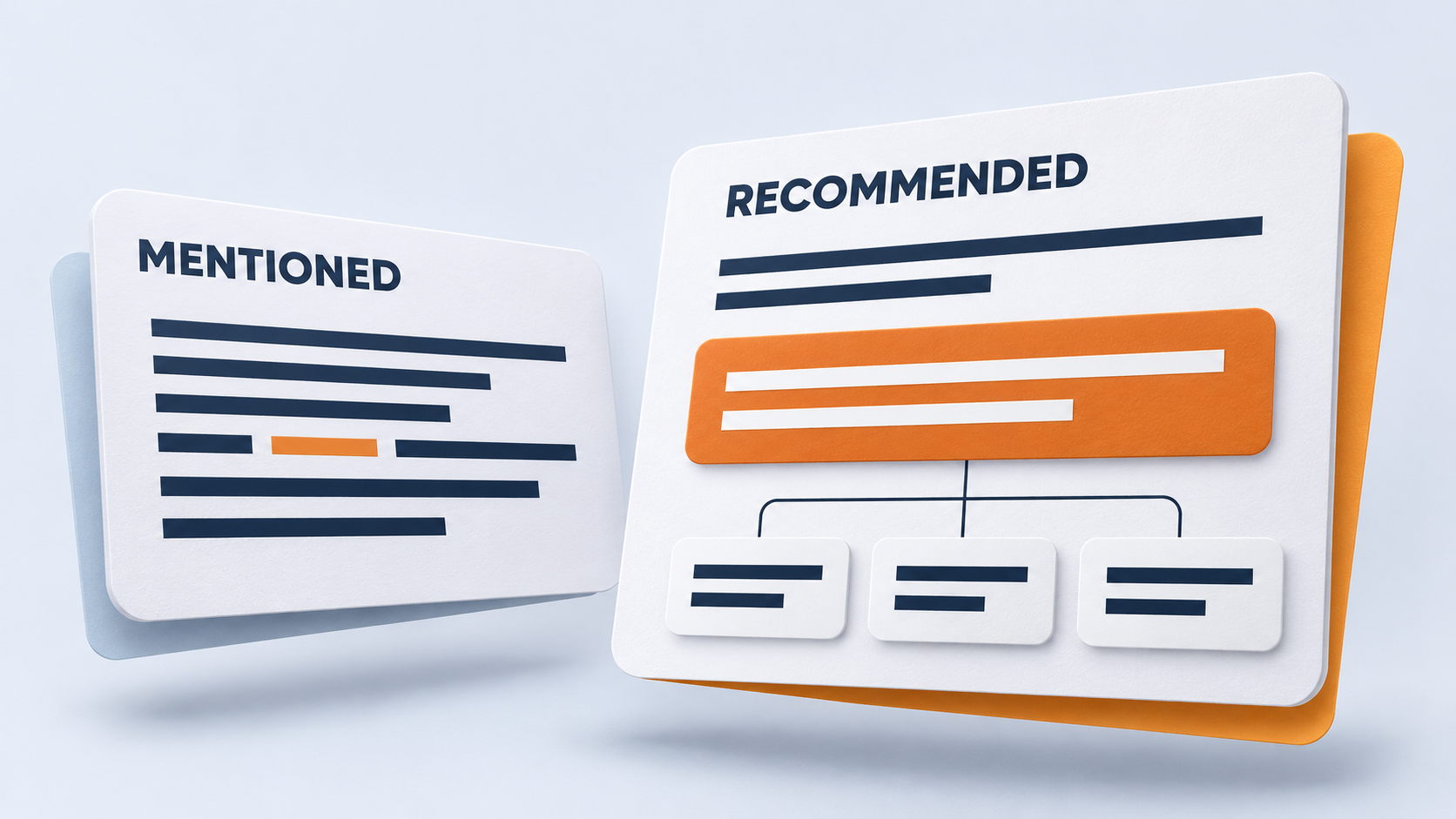
This is where AI visibility measurement needs to move beyond counting names. Presence, positioning, citations, and recommendations describe different parts of the answer. Keeping them separate makes it easier to see what needs work.
Mentions, Citations, and Recommendations Are Different Signals
These terms often get folded into the same conversation. They answer different questions.
A mention shows that your brand appeared
Your company might appear in a list of suppliers, a comparison, or a passing reference. The answer might be positive, negative, or simply descriptive.
Context determines how useful that presence is. Being described as suitable for small teams is helpful if small teams are your market. The same description becomes a problem when your product is built for complex enterprise deployments.
A citation shows which source the reader can inspect
When ChatGPT searches the web, responses may include linked citations. Those links let you inspect the material presented in support of the answer. OpenAI’s search guidance explains how these citations work.
Check the page behind the link. Your brand might be discussed through a review site, a competitor’s comparison, or your own documentation. Each gives the reader a different route into understanding your product.
A citation still needs checking. It does not automatically establish that the linked page supports the nearby claim, and it does not reveal every influence on the response.
A recommendation gives the buyer a reason to consider you
A recommendation connects your product to the situation described in the question.
That connection might involve integrations, budget, deployment requirements, industry experience, or a particular use case. The useful detail is the explanation of fit: why this company belongs in this buyer’s evaluation.
Even a favourable recommendation deserves scrutiny. If the reason given is inaccurate, the answer can create expectations your product cannot meet.
The Same Mention Can Tell Three Different Stories
Imagine a B2B buyer asking:
“Which customer support platforms should we evaluate if we need Salesforce integration and configurable data retention?”
Consider three fictional responses.
The first names your company alongside four others and moves on. You are present, but the buyer has little information to work with.
The second describes your platform as a basic option for small businesses. If that description is outdated, your name has appeared alongside a reason to dismiss you.
The third explains that your platform supports the requested integration and offers relevant retention controls, then directs the buyer to documentation where they can verify the details.
A mention count gives your company a tick in every case. Reading the answer reveals three different situations, each calling for a different response.
The example is illustrative, but the distinction is practical. Before treating an increase in mentions as progress, establish what those mentions are saying.
Whose Evidence Is Shaping the Answer?
There is another question behind the recommendation: where does the explanation come from?
A competitor’s comparison page may describe your product accurately in places while emphasizing the tradeoffs that favour its own offering. An old review may reflect a version you no longer sell. Your documentation may contain the relevant information, but leave the buyer to assemble it across several pages.
Where citations are available, inspect the sources and the claims they support. Look for outdated information, missing context, and differences between your current product and the description being repeated.
That inspection gives you evidence for the next decision. It can show that a source contains an old limitation or that an important capability is poorly documented. It cannot, by itself, prove exactly why the model produced a particular answer.
Start With Buyer Questions, Then Diagnose the Gap
Asking ChatGPT about your company is a useful check of how it describes you. It tells you less about whether somebody who has never heard of you will encounter you during research.
For that, you need the questions buyers ask while deciding what to evaluate: alternatives to an existing supplier, options that meet an integration requirement, or comparisons for a specific deployment.
The detail matters. A broad question about the best software in a category tests something different from a question about suitability for a regulated organization with an existing technology stack.
Once the questions are agreed, the work becomes more specific.
Check access and readable product information
For answers that use retrieved web content, investigate whether the relevant pages can be reached and whether their important information is available in readable text. Test the actual page and access conditions before assuming a technical problem.
Check how the product is understood
Compare the answer with current product information. Record where the category, capabilities, intended users, or limitations diverge. Then inspect whether your own pages and relevant external sources contain clear, consistent information.
Check the evidence available for the claim
A capability mentioned in sales calls may have little published support. A comparison may omit the requirements buyers care about. A customer example may describe a result without explaining the use case.
The intervention should follow the finding. Sometimes the useful work is correcting a page or improving existing documentation. Sometimes it requires new evidence or attention to an external source. The answer needs inspecting before the content brief gets written.
Measure the Answer Again
Save the question, full response, date, platform, available sources, and whether web search was used. Record relevant settings and conversation context too.
Then repeat the assessment under comparable conditions. Multiple observations help distinguish a recurring pattern from one favourable response.
Keep the question set stable enough to make the comparison meaningful. Report separately on whether your brand appears, how it is described, whether it is recommended for suitable requirements, and which sources are linked. As we explore in our article on why AI visibility does not transfer between engines, results also need examining by platform.
If the description improves after a change, record it. If it does not, that is useful evidence for the next cycle. An observed improvement is worth reporting without assuming that timing alone proves what caused it.
Read Past the Brand Name
A mention establishes presence in an answer. The explanation around it tells you what a prospective buyer might take away.
That is where the useful assessment begins: whether the product is understood, whether the recommendation fits the question, and whether the supporting evidence stands up to inspection.
Those are the questions behind our AEO and GEO approach. They turn a screenshot with your name in it into something a marketing team can use to decide what to do next.